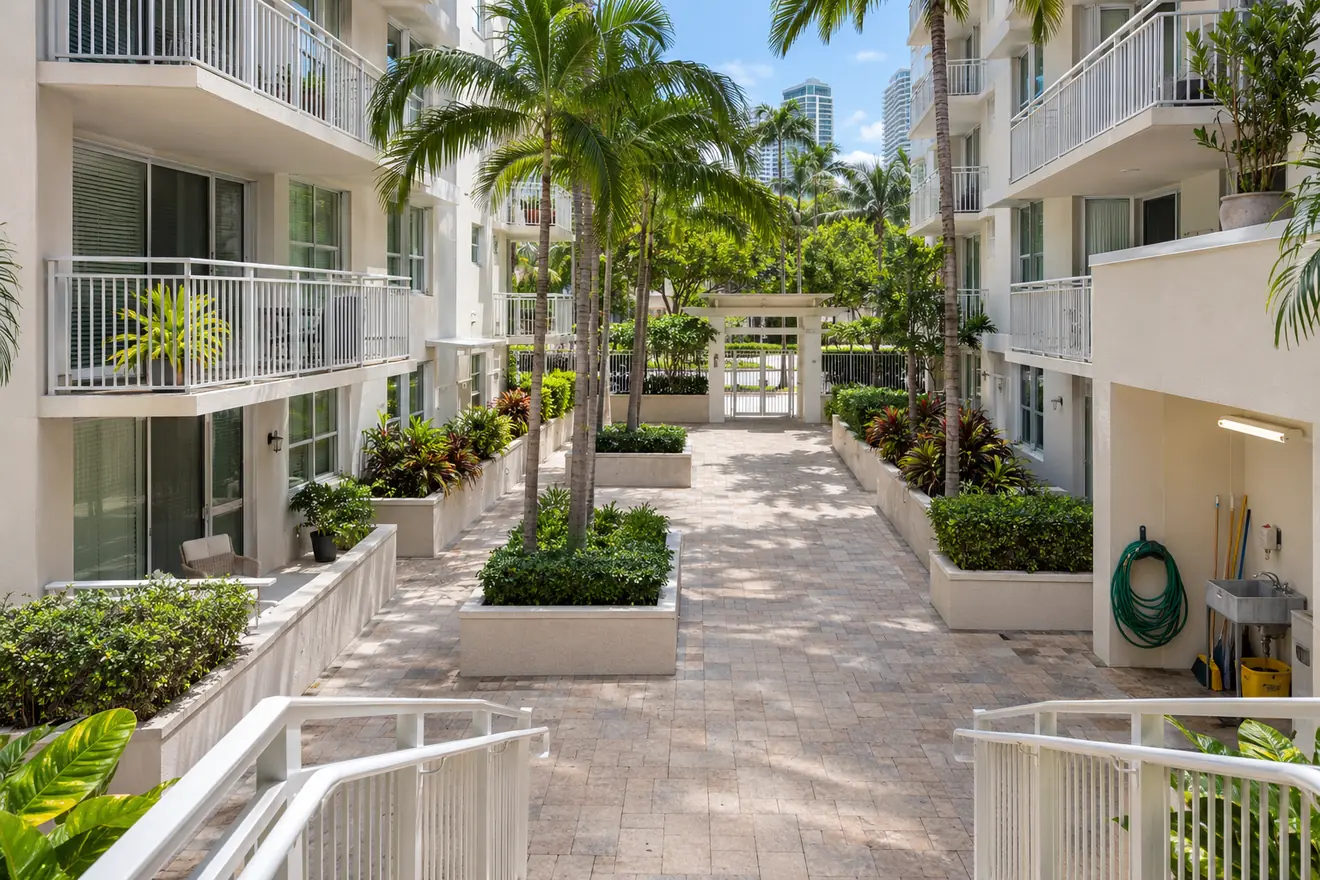
HOA exterior cleaning in Florida is split between the association and the owners, and what each side must do is set by the governing documents. Three rules of thumb hold up. Associations usually clean shared areas under a board-approved contract, individual owners are often required to keep their own exteriors free of mildew and stains, and any change in color, coating or finish usually needs approval first. Plain washing rarely does, but sealers, paint and coatings often do.
Start with the documents
Homeowners' associations in Florida are governed by Chapter 720 of the Florida Statutes, and condominium associations by Chapter 718. Both operate under their own declaration, bylaws and rules, which control what the board can ask of owners. Three documents are worth finding before you hire anyone:
- The declaration of covenants or condominium declaration. It states who maintains what and sets general appearance standards.
- Architectural or exterior guidelines. These list approved colors, materials and products, and explain the application process.
- Rules and regulations. They cover vendor access, noise and hours, parking and use of common water supplies.
Your association's manager or board can usually provide copies. If an item is unclear, ask the board for a written answer instead of relying on a verbal one.
Who cleans what in an HOA or condo
| Area | HOA community | Condominium |
|---|---|---|
| Entry monuments, perimeter walls, common sidewalks | Association, from assessments | Association |
| Clubhouse, pool deck, tennis courts | Association | Association |
| Building exterior, walkways, stairwells, garages | Not applicable | Usually association, as common elements |
| Individual home exterior, driveway, roof | Owner | Not applicable |
| Balconies and terraces | Not applicable | Depends on the declaration, often the owner for cleaning |
The table is a general pattern and individual documents vary, so treat it as a starting point. For work on shared areas, the commercial pressure washing guide covers contracts, scheduling and wastewater, which apply just as much to a community as to a plaza.
Why condo balconies and walkways vary
For condominiums the statute sets the default and the declaration adjusts it. Section 718.113 says maintenance of the common elements is the responsibility of the association, but the declaration may assign upkeep of certain limited common elements, such as a balcony that only one unit uses, to the owners who use them, or have the association maintain them either as a common expense or at the cost of only those users. That is why one building bills owners for balcony cleaning and the next building does not. The text of section 718.113 is on the Florida Legislature website.
Hiring on behalf of a community
Florida law sets a floor for competition on larger contracts. An HOA must obtain competitive bids when a contract exceeds 10 percent of its total annual budget, including reserves (section 720.3055), and a condominium association when it exceeds 5 percent (section 718.3026). Many boards collect several written bids even below those thresholds, compare scopes rather than totals, and approve the winner at a meeting recorded in the minutes. A solid bid for a community lists:
- Every area covered, such as sidewalks, curbs, monuments, mailbox kiosks, pool deck and walls.
- Cleaning frequency, for example quarterly or twice a year, and a rain policy.
- Methods for each surface and how landscaping will be protected.
- Wastewater handling, particularly near storm drains and retention ponds.
- Proof of insurance with the association named as an additional insured.
- Resident notice: when work happens, whether cars must be moved, and how to ask questions.
County watering limits are covered on the runoff page; for a community contract, the bigger issue is where the wash water goes.
What the bid rules do not require
Neither statute forces the board to take the lowest bid. Both carve out exceptions, including emergencies, contracts with association employees, and cases where a vendor is the only source of supply within the county. For condominiums, section 718.3026 also requires contracts for services to be in writing, and it lets an association with 10 or fewer units opt out of the bidding rule by a two-thirds vote of the unit owners. Methods differ a lot between roofs, stucco and concrete, so a bid that names the method per surface is easier to compare; see soft wash vs pressure wash for what each method suits. Boards vetting a vendor can use the checks in how to choose a pressure washing company.
How owners can see the bids and contracts
Owners are entitled to look at them. Under section 720.303, an HOA's official records include its current contracts and a list of the bids it received within the past year, and the association must make records available within 10 business days after the board receives a written request from a parcel owner. Condominium associations follow section 718.111(12), which also lists contracts and bids, gives 10 working days, and requires bids to be kept for at least one year. Send the request in writing, name the records you want, and keep a copy. The HOA records statute is on the Legislature's site.
When a violation notice arrives
A letter from the association about mildew on the roof, a stained driveway or a grimy wall is common, because most declarations require owners to keep their property in good repair and clean. Florida law gives owners procedural protections before a fine is imposed. Under section 720.305, an HOA board must give at least 14 days' written notice of the owner's right to a hearing, and the hearing must be held within 90 days of the notice before a committee of at least three members who are not officers, directors or employees of the association. A fine may not exceed $100 per violation, and daily fines for a continuing violation are capped at $1,000 in total, unless the governing documents provide otherwise. If the problem is cured before the hearing, or in the way the notice specifies, no fine can be imposed. You can read the statute on the Florida Legislature website. Condominium associations have a comparable process under their own chapter of the statutes. For disputes, talk to a qualified attorney.
Most of these notices can be resolved by cleaning the surface within the deadline and replying to the board with before and after photos. A professional wash is often faster than a do-it-yourself attempt, particularly for roofs.
How to respond to an HOA exterior clean-up letter
- Read what the letter actually cites. Note the surface (roof, driveway, wall, fence), the rule or covenant it relies on, and the cure date. The deadline in the notice is what counts, not a general sense of "soon."
- Clean it in the way the notice specifies. Under section 720.305, a violation cured before the hearing, or in the manner the written notice specifies, cannot be fined. If the letter says nothing about method, ask.
- Match the method to the problem. Black streaks on a roof or green film on a shaded wall are usually algae or mildew; the mold and mildew guide explains how they are told apart and removed. Fences and wood decks need lower pressure than concrete, as covered in the wood deck and fence cleaning guide.
- Reply in writing. Send the board or manager a short message with dated before and after photos, and keep a copy. A written record answers a later claim that nothing was done.
- Ask for the hearing if you disagree. The right exists for HOA members before a fine is imposed, and an uncured violation can only be fined if the committee approves it.
Condo notices follow a different clock
Section 718.303 sets a similar structure for condominiums: the board must give at least 14 days' written notice and an opportunity for a hearing before a committee of at least three members appointed by the board, who cannot be officers, directors or employees of the association. A fine may not exceed $100 per violation or $1,000 in the aggregate, may be levied per day of a continuing violation, and cannot become a lien against the unit. The condo statute says an approved fine is due 5 days after notice of it, which must be given by mail or hand delivery, while the HOA statute sets at least 30 days after the written notice is delivered. Read the text of section 718.303 and your declaration, since governing documents can add their own steps. Statute wording is as published on the Florida Legislature site in November 2026 and can change.
Mediation for covenant disputes
If a disagreement about covenant enforcement or changes to a parcel cannot be settled with the board, section 720.311 provides presuit mediation for many HOA disputes. It does not cover the collection of a fine or other financial obligation. A qualified attorney can say which path fits your case.
Approvals for coatings, sealers and paint
Under section 720.3035, an HOA may review plans for exterior appearance only to the extent the declaration or published guidelines give it that authority, and it must apply those standards to all owners in a reasonable and equitable way. If you plan to seal pavers, apply a roof coating, or repaint, check the guidelines before starting. Plain washing is typically maintenance, but a change in color, sheen or product type may require an application. If you are washing a house as prep for repainting, the guide to washing before painting covers drying times, and the paint color itself is the part to get approved. If a request is denied, the HOA must give written notice that identifies the specific rule or covenant and the part of the proposal that does not conform. The statute also limits an association's ability to deny conforming hurricane protection such as shutters or impact windows, which is relevant when scheduling work around storm preparations. The hurricane season guide explains how cleaning fits into that timeline.
In a condominium, the building itself is common property. Under section 718.113(2), material alterations or substantial additions to the common elements need approval as the declaration provides, and where the declaration has no procedure, 75 percent of the total voting interests of the association must approve them. Routine cleaning is maintenance rather than alteration, but a new coating or color on common elements is the kind of change worth raising with the board first.
Practical tips for owners
- Ask whether the association already has a preferred vendor with an active insurance certificate. Some require it for work on common property.
- Confirm whether a gate code or vendor registration is needed so a crew is not turned away.
- Check working hours and noise rules before scheduling.
- Confirm where wash water will drain. Retention ponds and swales are part of the community's stormwater system. The page on runoff rules explains why that matters.
- Keep records of quotes, approvals and photos.
Frequently Asked Questions
Can my HOA require me to pressure wash my house?
Many declarations require owners to keep exteriors clean and in good repair, which can include removing mildew. Enforcement must follow the notice and hearing process in the statute and your documents.
Do I need approval to pressure wash my driveway?
Usually not, since it is maintenance. Approval is more likely to be needed for sealing, staining, painting or changing the surface.
Who pays for cleaning building walls in a condo?
Often the association, as a common expense, but it depends on the declaration. Check how the exterior and limited common elements are defined.
Can the board pick the vendor without bids?
Not for larger contracts. Under section 720.3055, an HOA needs competitive bids once a contract exceeds 10 percent of its total annual budget, including reserves, and section 718.3026 sets the line at 5 percent for condominiums. The HOA statute does not require the board to accept the lowest bid.
Can I be fined immediately?
No. For HOAs, section 720.305 requires at least 14 days' written notice and a hearing before a committee of owners who are not board members or employees, and no fine can be imposed if the violation is cured before the hearing. Condominiums follow their own statute and documents.
What happens if I clean the surface after getting an HOA letter?
If you cure the violation before the hearing, or in the manner the written notice specifies, section 720.305 says the HOA cannot impose a fine or suspension for it. Reply in writing with dated photos so the cure is on record.
How much can a Florida HOA or condo fine for a dirty exterior?
For an HOA, a fine is capped at $100 per violation, and daily fines for a continuing violation at $1,000 in total, unless the governing documents say otherwise (section 720.305). The condominium statute sets the same $100 and $1,000 caps (section 718.303) and does not include that exception. In both cases the fine needs notice and a committee hearing first.
Can an owner ask to see the association's cleaning contract and bids?
Yes. Contracts and bids are official records, and the association has 10 business days (10 working days for a condominium) to make them available after a written request (sections 720.303 and 718.111(12)). HOA records include a list of bids from the past year.